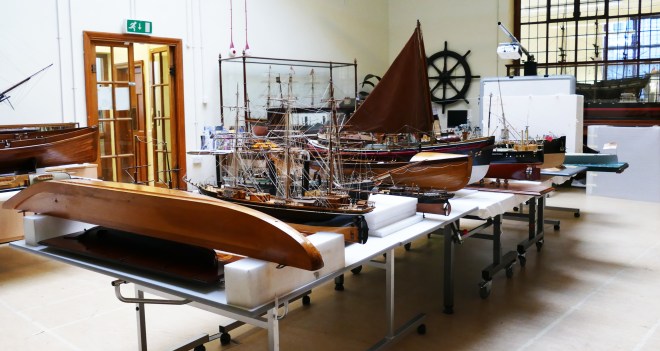
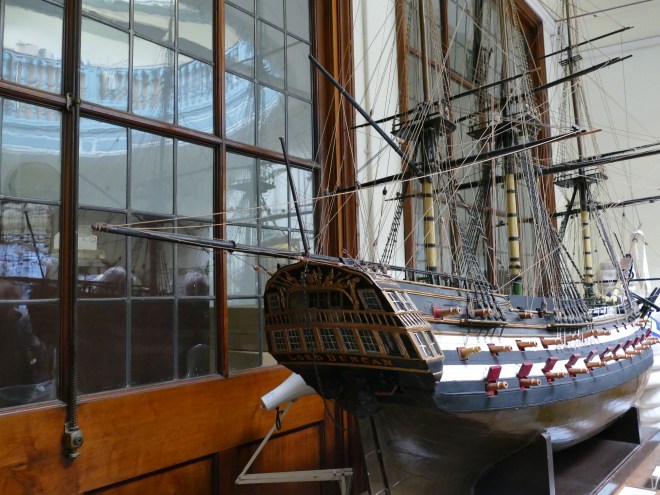
The beautiful model ships conserved and stored at the McManus Collections unit in Dundee have now embarked upon a new voyage. Destined for a new display in the Albert Hall at the McManus Galleries.
Bishop’s Move, a removal, and international shipping service ascended upon the unit at Barrack Street, to oversee the final voyage. The models had been packed carefully into boxes while other large models were carried by hand onto a bright yellow lorry. The museum staff Becky and Carly watched apprehensively, hearts racing as the fragile glass display cases were moved from their safe spaces. Each model was destined to travel adjacent to the flow of River Tay to Noth Sea, roughly 300 yards to the gallery, in blustery windy conditions.
The Tay Estuary has seen many great ships built and launched, from high-quality wooden vessels, sailing barques and iron steamships. All built by local shipbuilders including David Livie and Sons, Alexander Stephen and Sons, Gourley Bros and Caledon. Each ship produced from Dundee’s past carried a tale to tell and by clicking the link below you can hear a ship launch story.
The Ship Models new permanent exhibition will be ready for visitor’s inspection at the magnificent Albert Hall in the McManus Galleries, early May 2017.
Please note: Audio file is on loan from theCultural Services Oral History.
[1] Monroe, H & Henderson, A. ed. (1918). The New Poetry, An Anthology. New York: The MacMillan Company. P200-202.
I’m looking forward to the ship models being moved to ‘The McManus’ for a new permanent exhibition, opening early May 2017 and I have been invited to document the process at the end of the month. This invitation has launched my thinking upon the place of Dundee’s shipping past. I find myself transported back to ‘Stannergate’ overlooking the Tay Estuary. The image above presents the shoreline where ‘Caledon Shipyard’ once built many ships, the ship’s names float gently upon white capped waves.
Queen Victoria and Prince Albert have had a long-standing connection to Dundee’s past. This union will once again be transported into the future by the completion, early next year of the V&A Museum of Design Dundee.
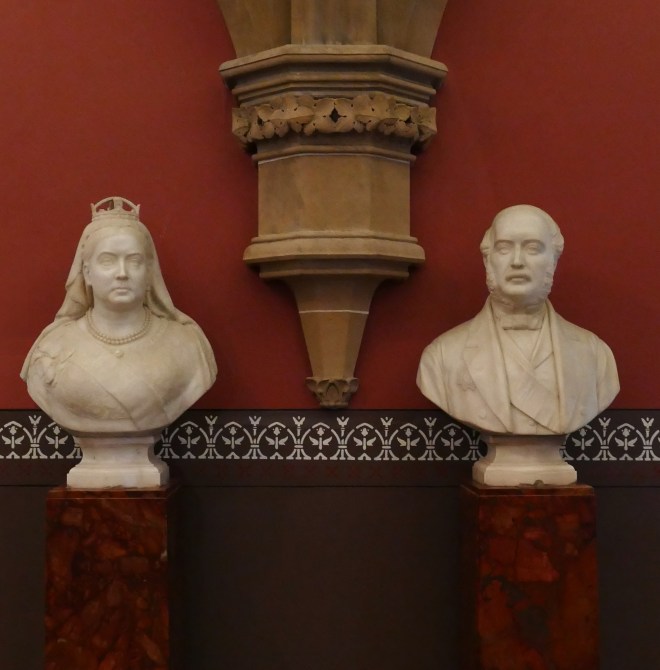
Victoria and Albert patiently await the completion of Dundee’s V&A
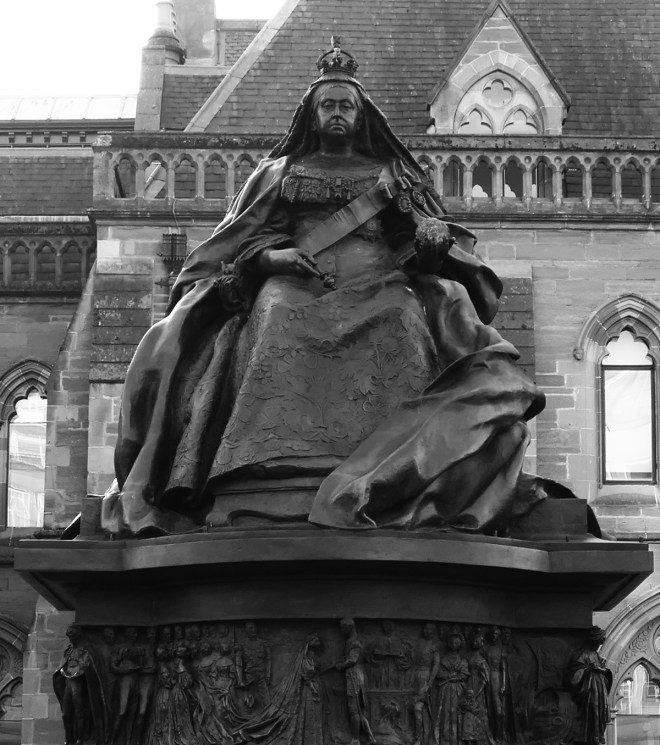
The McManus: Dundee’s Art Gallery and Museum is built upon Albert Square, a place named as a monument to Albert, the Prince Consort.[1] A statue of Queen Victoria can be found on the square and the museum was once named ‘The Albert Institute’. However, its name changed to ‘The McManus Galleries’ in memory of the former Lord Provost, Maurice McManus.[2] Historically Dundee has always had its own V&A, found on the first floor of the museum in the form of ‘The Victoria Gallery’ and ‘The Albert Hall’. You can also find two busts, sculpted by John Hutchinson in 1898, of Queen Victoria and Prince Albert located near the entrance of the museum.
Queen Victora outside the McManus Gallery
My intention when photographing the busts was to represent, ‘Victoria and Albert patiently await the completion of Dundee’s V&A’. However, when I visited the museum I noticed the Prince Consort ‘s sculpture stood to the right of the Regnant Queen. Albert and Victoria seems a little odd so I altered the image in Photoshop, placing the queen on the right with the prince on her left.
Original Photograph
A curatorial decision was made to place the queen on the left side of her husband. Was this decision made so the Queen would be nearer the front entrance? Or, was it an old fashioned concept of a woman’s place is on the left of man? If we think of a Christian wedding where the bride always stands or sits to the left of her husband and her family also sits on the left side of the church. I began to search for some context and I found an article suggesting:
“Traditionally, when a man escorts his partner, he offers his left arm. This tradition originates from medieval times when men escorted women around town and through the fields. Should a threat arise or the woman’s honor require defending, the man’s sword hand (his right hand) would be free, giving him quick and easy access to his sword, worn on his left side.”[3]
During my research, I also found a guide to the correct royal etiquette for various modes of royal seating at court and at other times, recommending;
“The Sovereign sits to the right, with the Consort to His (or Her) left, if both are present.”[4]
When I think of any images I have seen of our current royals, we nearly always find Prince Philip sat on the Queen’s left side. Yet, regardless of the positioning of Queen Victoria or Prince Albert’s sculptures, when I consider the skill and craftsmanship of the work and the beauty of the marble. I reflect upon their royal romance, as we all wait patiently for their union to be transported into the future by the completion of Dundee’s V&A.
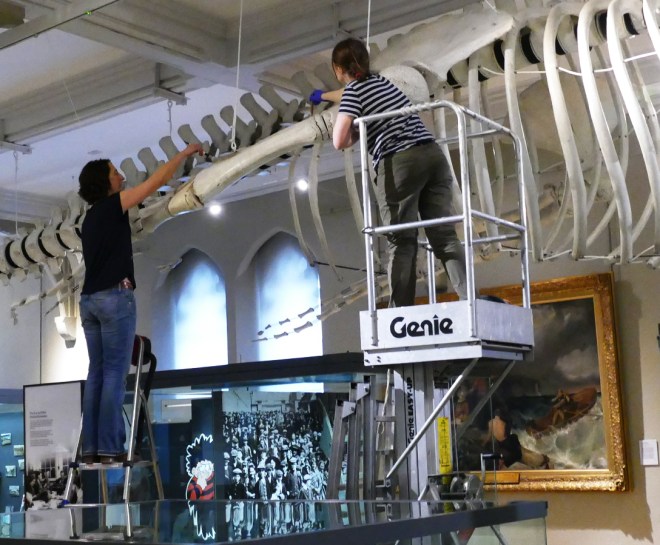
On a recent visit to the gallery, I found the McManus conservation team busy cleaning the ‘Tay Whale’, a skeleton of a Humpback whale located in the ‘Making of Modern Dundee’ exhibition. The ritual spring clean is an opportunity for the museum to clean and re-examine its displays. The conservators Becky and Carly undertook the intricate task upon a scaffold, equipped with a specialist vacuum cleaner and soft brushes. To prevent damage, they first gently brushed the dust from the many bones and then vacuumed the surface.
I was not surprised to find the museum cleaning a day after the spring equinox (the 21st of March). Yet, I began to wonder, why do we spring clean? Traditionally, spring is a time to open all the windows, to do a thorough clean, but it is also a time to celebrate rebirth and new beginnings. The conservator’s act of cleaning helps to preserve the bones of a long-dead creature, maintaining its legacy beyond death.
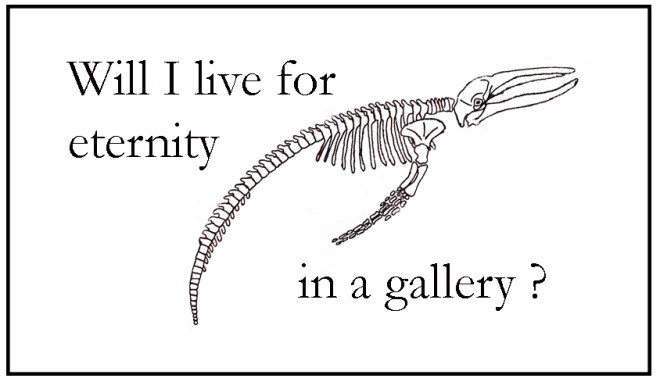
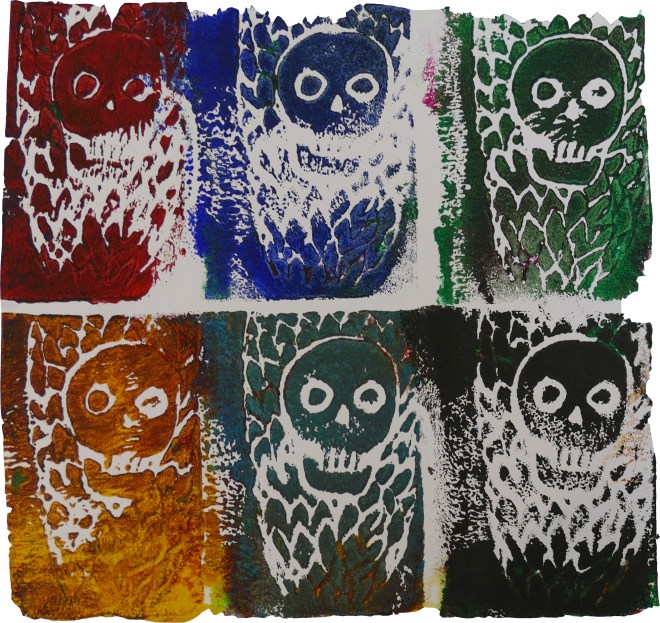
Image from a German exchange student inspired by a gallery spring visit
The whale story is immortalized by its preservation, allowing the story to be re-told. Visitors will question why this unfortunate whale a creature that lived in the sea, ended up in a gallery? It swam up the Tay in 1883, evaded capture, eventually died and was towed ashore at Stonehaven. [1] John Woods bought it at an auction and donated the skeleton to the museum. The famous Dundee poet McGonagall wrote a poem about the whale’s experience. On the strength of the Tay Whale poem and other verses, he was acclaimed to be “the worst poet in the English language”[2]. Here is an example of the first verse.
’TWAS in the month of December, and in the year 1883,
That a monster whale came to Dundee,
Resolved for a few days to sport and play,
And devour the small fishes in the silvery Tay.[3]
The whale lives on in object and tale. I believe each spring clean represents the preservation of the life force, still present in a dead inanimate object. [4] When we clean “we are negotiating with our mortality” [5]. In death, we return to dust and in time we are forgotten. The action of cleaning the bones, fundamentally allows the conservators to attempt to control the rate of the ‘Tay Whales’ demise.
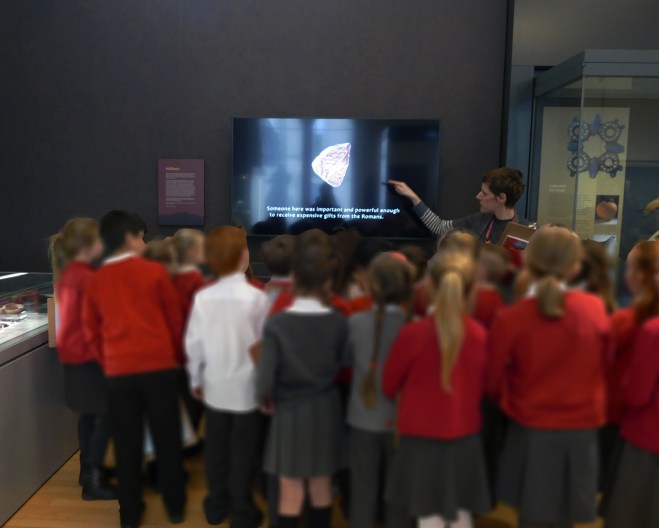
On Wednesday 1st of March, I attended a workshop for school children, run by the learning team at the McManus: Dundee’s Art Gallery and Museum. The workshop explored the ‘Refection of the Celts Exhibition’ where the children loved discussing the culture, discovering the exhibition and making Celt inspired helmets.
On display in the ‘Refection of the Celts Exhibition’ hangs a painting called ‘Riders of the Sidhe’ by a Dundonian painter John Duncan. He painted this after spending time exploring Eriskay, Barra and Iona. [1] He describes;
“The mystery, exuberance and restraint of Celtic art”.[2]
These feeling can be sensed as you wander around the exhibition and I began to think about artifacts and the exhibition experience, how do they add to the children’s understanding of the Celts? I believe the answer lies in a Celtic atmosphere created by the exhibition and the children freedom of choice.
The school group gained knowledge by exploring, experiencing and researching the Celts through objects by applying;
Curiosity: Free to question and select what objects to look at and draw.
Collaboration: They organise themselves into groups for the creative activity, this allowed each group to work well together.
Creativity: Instruction was given on how to make the helmets but they were free to decorate using their own designs influenced by their research and experience.
Here some examples of their work.
[1] Jarron, M (2015). “independent & individualist” Art in Dundee 1867-1927. Dundee: Abertay Historical Society. P81.
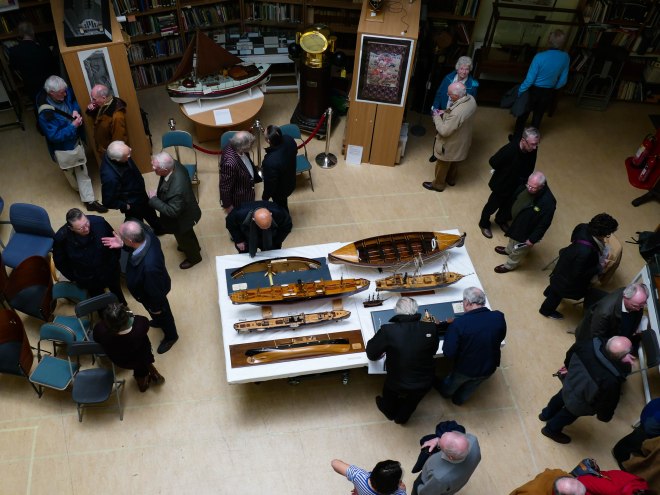
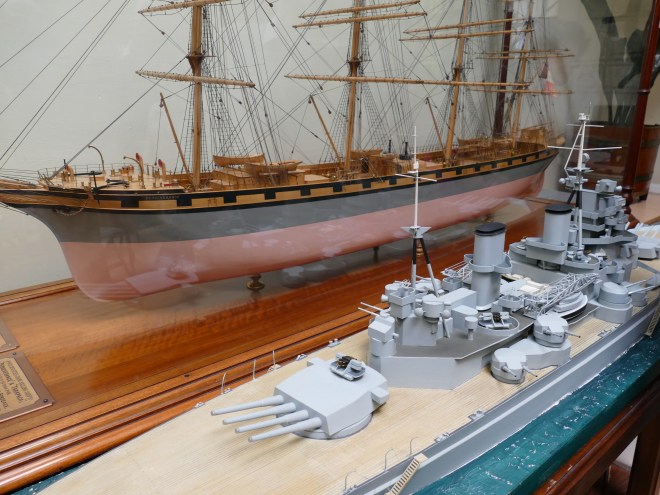
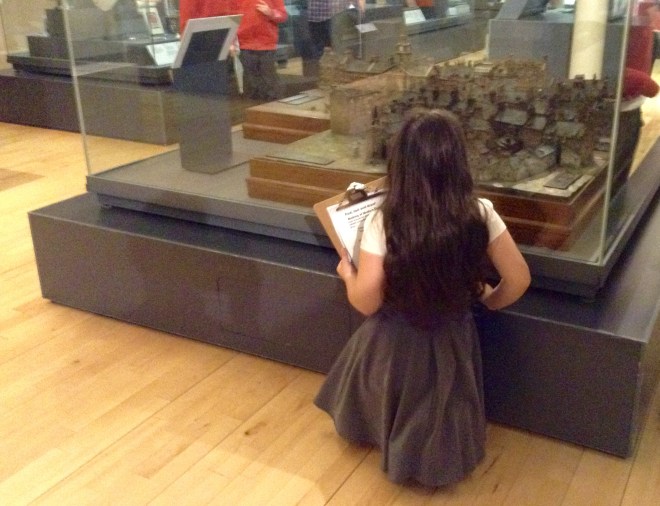
I attended the Ship Model Study day on Wednesday 22nd of February, at Barrack Street Museum Collections Unit. The collection has over ninety different models, some built by local amateurs enthusiast while other models crafted by ship builders who commissioned them to attract support and investment.
Over fifty people attended the study day, the majority, were local men who wanted to discuss and share their fascination for these models. It amazed me, how a model, a copy or imitation of a real ship could build discussions, sharing culture and establishing a romantic notion of Dundee’s shipping history. John Duncan described a nostalgic image of Dundee Docklands in his speech in 1911.[1]
“Strange ships from many strange places: huge swollen Dutch hulls that looked too lazy for anything but a canal, and lean sea-going ships; and full of foreign folk; swarthy creatures like pirates from the Spanish Main: Chinamen and Hindoos, and an occasional Lapp; lanky, blue-eyed Scandinavians talking together an unintelligible tongue. And queer rigging, and carving, the figureheads, and windows in the stern, the gilding, and the paint, and the whitewash, and the tar; and the moving water caught all this picturesqueness, and shook it into twisting Chinese dragons of liquid dancing fire. What a wonder it all was, what a delightful place for a Sunday afternoon.”[2]
The group engaged with each model in three stages: denotation, demonstration, and interpretation.[3] I questioned a few visitors about the appeal of a model ship and the responses were varied. Some interest was developed from working in the shipping industry, while others simply admired the craftsmanship and attention to detail. All agreed these models evoked the imagination of what it was like to live and work on the ships. The model ships allowed the construction of a narrative beyond the object.
A small collection of carefully chosen ship models, representing ships that sailed from Dundee or tell a Dundee story. Will be soon be moved and displayed in the ‘Dundee and the World exhibition’ at the McManus galleries.
[1] Jarron, M (2015). “independent & individualist” Art in Dundee 1867-1927. Dundee: Abertay Historical Society. P100.
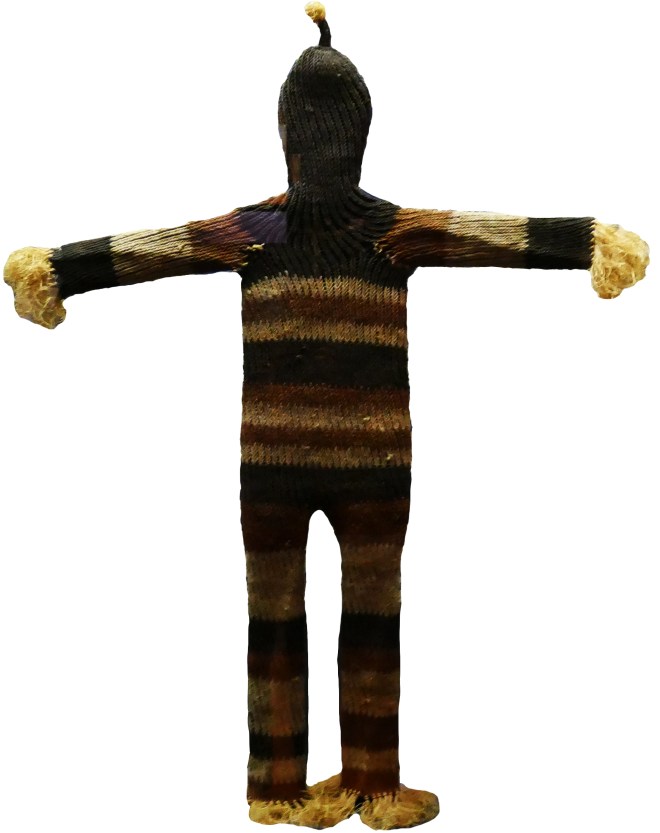
Last night I joined the ‘YAG’s’ (the Youth Action Group) for a wander around the ‘Dundee and the World’ exhibition located in the magnificent Albert Hall at the McManus Galleries. The group wanted to sketch and discuss some of the things on display. However, I did not expect a discussion to be focused on “Dundee’s oldest Onesie”, a quote from a member of the group.
This ‘Onesie’ is not an adult sized babygro but an early 20th century costume worn as a disguise, by members of the Nigerian Ekpe secret society, made from Netted string and Raffia.[1] Yet the discussion provoked themes of youth culture and the fashion of wearing a giant romper suit. The interaction between the group and the object began to build their sense of identity by exploring something from the past and comparing it to present fashion culture, highlighting;
“The passage of time, which operate predictability on the objects themselves, can do strange things to their meanings, and the importance of some will change as a result.”[2]
The museum carefully archives artifacts with specific historic details and dates to preserve valuable objects, a value created by a society it represents. Yet a different time and culture can randomly change meanings. In the future, will people venture into a museum to see the ‘Onesie’ on display? What meaning will it transcend? And will they think we are a society of big babies?[3]
A story about the restoration of a Khalkha Mongol Headdress (pre-1900), loaned to the McManus Galleries in Dundee by L J Miller (1931).[1]
The Khalkha Mongol Headdress has been selected, restored and cared for by the McManus. The conversation reveals an object expressing meaning beyond its physical presence within the history of specific events; Mongolian trade routes, craftsmanship and the possible design influence of a headdress worn in Star Wars, Episode 1: The Phantom Menace.
The vocal sound creates meaning found outside language and the spoken word.[2] Inside our perception, the vocal sound allows you to hear the affect the headdress’s journey has had, on the speaker’s feelings.
“Feelings may also link feelings, and this superimposed relationship leads us to an in-between of in-betweens…”[3].
What we hear in tone and vocal expression reveals emotion. To listen and contemplate to the story, bridges us between our personal and shared feelings towards treasured objects. Binaural microphones were used to create an intimate listening experience, locating us in-between the self and the other. And the reverberating sounds of space in the museum, places us from our physical location to the museum, in-between here and there.
[2] “… as Ricoeur says, meaning or significance is already both perception and word.” Ihde, D. (2007). Listening and voice: Phenomenologies of sound. 2nd ed. Albany: State University of New York Press. P148
[3] Asenjo, F. G. (1988). In-between : an essay on categories, Center for Advanced Research in Phenomenology & University Press of America, Washington, D.C P139
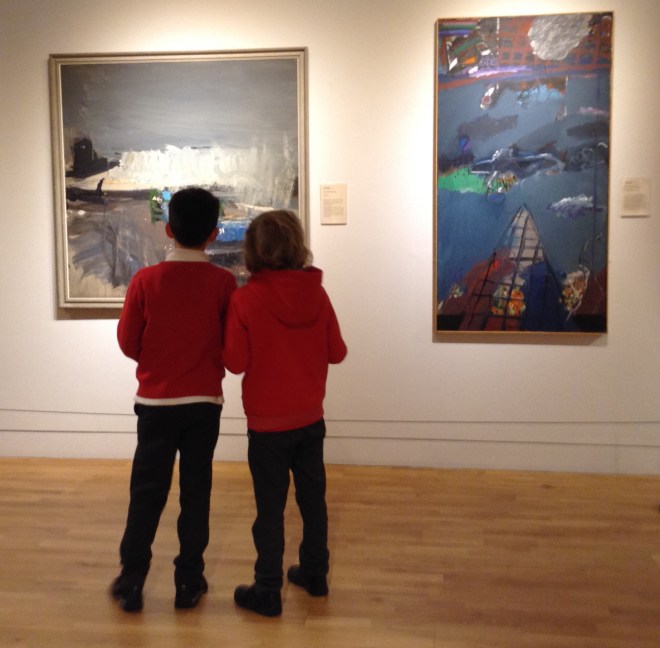
I was asked to attend the gallery as an introduction to how the creative team at the McManus work with groups. Ninety school children from Broughty Ferry ascended upon the museum, to learn about a Bonnie Prince and some Jacobites. Fortunately, the creative team had logistics already in place, to navigating so many children carefully around the gallery space. I watch as military precision and planning was organised that would make any soldiers heart race. Two hours later a troop of happy children marched out bearing newly made Jacobite shields and returned, homeward bound to the ‘Ferry’.
Things I have learned about children in a museum:
Ninety children are very loud in an acoustic space.
Movement in the space has to well planned and organised.
Children spend a lot of time looking up or crouching down.
They mix factual and fictional description of things.
They enjoyed interacting with the space in the gallery.
Please note: Documentation for this project has photographic restrictions in place.
I have recently started (a Making the Most of Masters) student placement at the McManus, Dundee’s Art Gallery and Museum. Working on a project called ‘The People’s Story’, running as part of a programme organized by the museum’s Learning & Engagement Team to celebrate the 150th Anniversary of the McManus. The project will explore the relationship between Dundee’s diverse communities, the museum and its collections.
The McManus already has an established form of engagement with a wide range of groups, trustees and communities. Each group engages with the museum in a different way and I would like to consider, what is normal? How do these different audiences normally engage with the museum, the gallery space and interpretation of its artifacts?
Beginning a project is always a daunting task but I’m happy to be working with a fellow student, Stuart McAdam and the creative learning team. To begin my journey, I have decided to treat it like a walk. ‘The People’s Story’ will allow for an exploration into the relationships between city and the museum. Giving me the resources to collect stories about Dundee and to continue my research, into the dynamic engagement of public and private spaces, using similar methodologies from previous projects involving the tramlines and edgelands of Dundee.
***
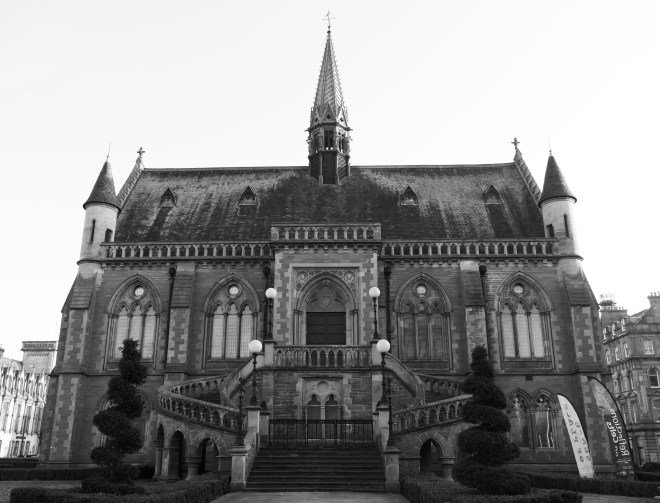
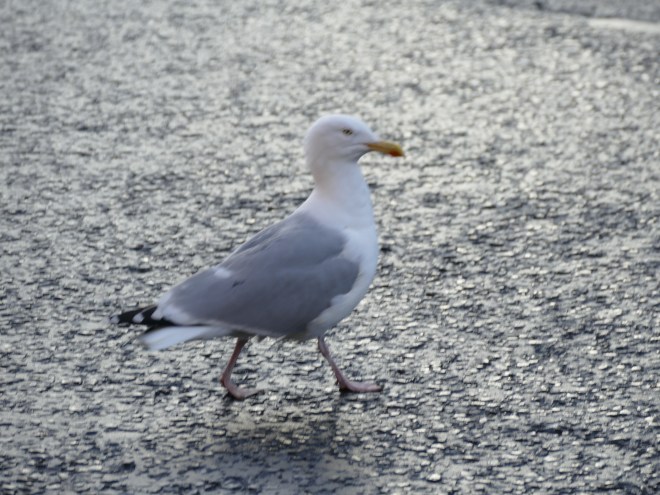
Quite unexpectedly, my first visit involved being followed by a Seagull who seemed to be heading in the same direction, the McManus, Dundee’s Art Gallery and Museum.
My initial walk through the McManus was to observe the building, space and collections.
Everyday objects from seemingly insignificant past events have just as much validation as an object from a significant historical event.
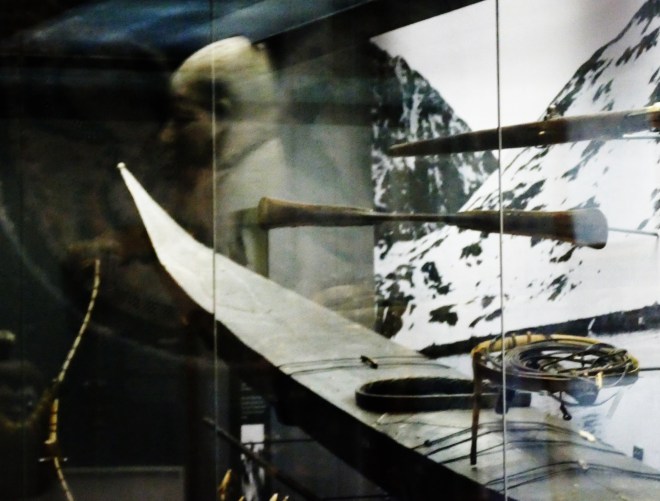
I noticed the reflections of objects, being mirrored upon the glass of the display cabinets. This reminded me of the process of memory and how people’s stories could place new memories, upon old memories projecting, spatially into a fourth dimension.[1] I wondered if a soundscape of stories collected around and about the McManus could also project into a new dimension.
I considered how a walk around a gallery, allowed the place to suggest appropriate sounds. I felt a sense of urgency moving in-between emotions and happenings. A sonic signature is an in-between space where the place is the symbol and the sound, the meaning.[2] The sound of a museum creates an in-between awareness. How people feel in the museum, or about its historical objects, could add something unique to our perception of the McManus and within that thought I found a new line of direction.
[1] “the process is that of continually compounding one and the same topomnesiacal resource.” Casey, E.S. (2002) Representing place: Landscape painting and maps. Minneapolis: University of Minnesota Press.p77
[2] “Thus for the poet in his ecstasy- or perhaps, agony- of the composition the trees are the symbols and the words are the meaning. He concentrates on the trees in order to get the words.” A.N Whitehead (1985). Symbolism: Its Meaning and Effect. New York: Fordham University Press. P12.










 THE ARTFUL DONDER